maintenance Smart Residential Living uncategorized

Property Taxes slated to increase with BBMPs proposal to include common area as well for computation

600x600-3

Are you tired of the high property tax, that you have to pay every year? Unfortunately, this will only increase further with BBMP proposing a plan to charge property tax on the common areas in commercial and apartment complexes. Common areas are playgrounds, swimming pools, gardens/lawns, parking spaces etc. All this while, flat owners in a way were paying less tax, says BBMP, as taxes were only being calculated as per the carpet area which is the actual usable area minus the wall thickness. However, since the common areas are used by all on an overall basis, the tax thus paid is comparatively less.
600x600-3

Considering this fact along with BBMP’s need for a higher influx of revenue where they are eyeing a 40% increase, they have planned to charge the common areas used by property owners in their gated communities. Also, club houses and community halls would be taxed separately as communities rent these out for functions and other commercial purposes. In other words these will be treated as any other commercial building and will be taxed in the same manner, the way any supermarket or a mall is charged for property tax.

If you are still wondering about calculations well here’s an example. If you are living in a community with 20 flats, each having a sq ft area of 10,000 for which each flat owner is paying tax individually. Now there are common areas like store room, gym, lawns etc. which all together takes up a sq ft area of 15,000. This 15,000 sq feet area would be proportionately divided among the 20 flat owners.

BBMP is currently only doing the required surveys and has ordered all the tax inspectors and revenue inspectors in each ward to survey the apartment complexes and ascertain the quantum of payments that requires to be made. The survey has already started in Mahadevapura and Bommanahalli zones and will soon reach the other parts of the city. Also, BBMP is studying the tax calculation on common areas made in other metropolitan cities before bringing about this move in a full-fledged way.

However, many apartment owners are not taking this change happily and feels that maintenance already covers the tax on common areas.

Do you think BBMP has made a fair move or is it unnecessary? Do let us know your thoughts on this in the comments section below.

Source:http://www.deccanherald.com/content/483211/tax-likely-apartment-pools-parking.html
Read More
Product Updates Right Step Smart Residential Living uncategorized

Money Manager Discounts Feature Added

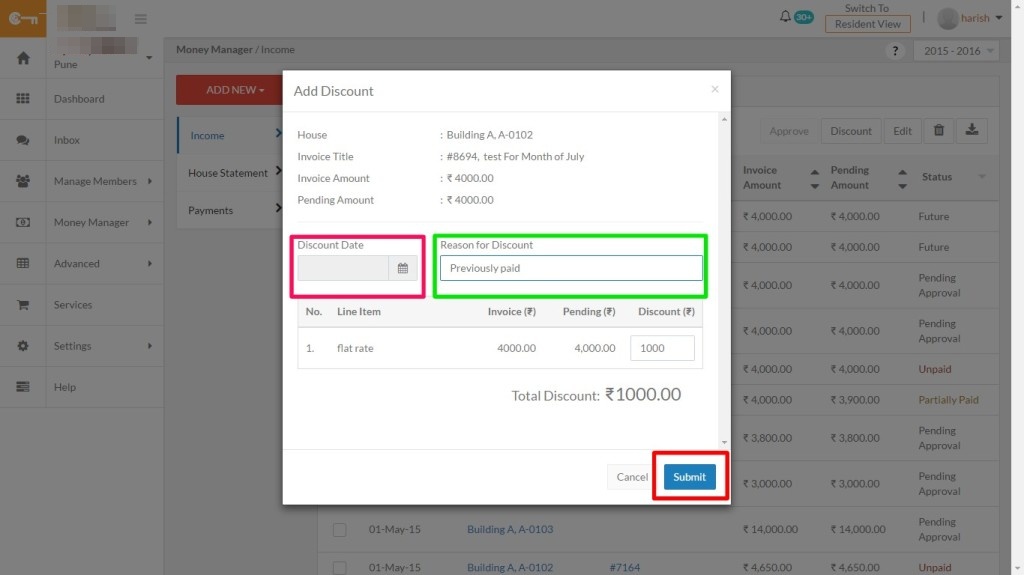
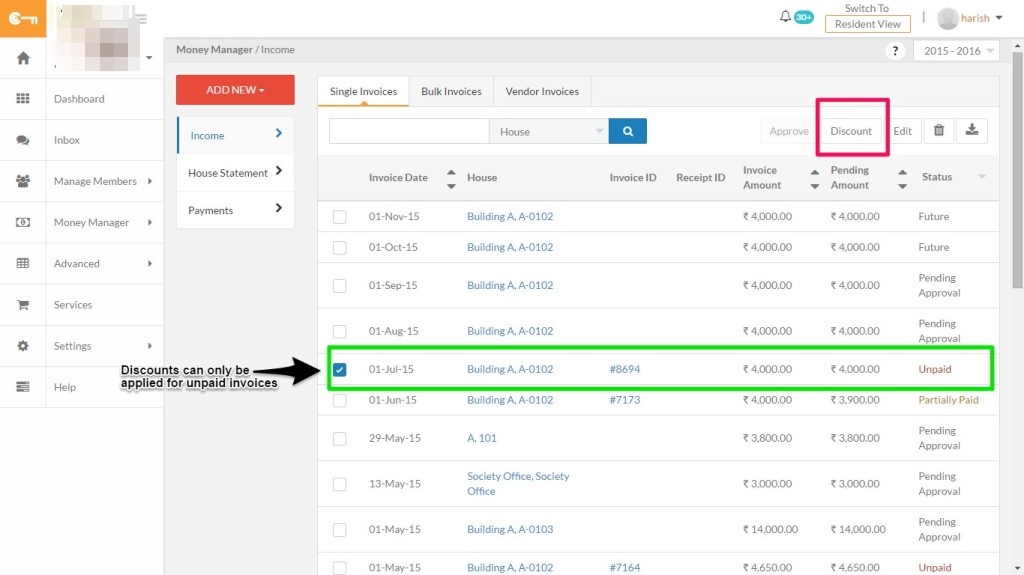
With CommonFloor Groups, Treasurers can easily apply discounts either for single invoices or for bulk invoices. Purpose is to waive off a certain amount of the invoice raised, if required, so that it no longer shows as a Receivable from that house.
Path: Money Manager > Income> Single/ Bulk Invoices

Note: Discounts can only applied for unpaid invoices.

1discount-applied-1024x575

Click on the discount button and you’ll get a pop up box. Enter the discount amount, discount date and the reason for discount. Discounts can only be accessed by level 3 (L3) and level 4 (L4) admins who are the property managers and treasurers.

2how-to-apply-discount-1024x575

Once discount is applied the system will consider the invoice as partially paid and you can filter the status of the invoice as discounted and view.

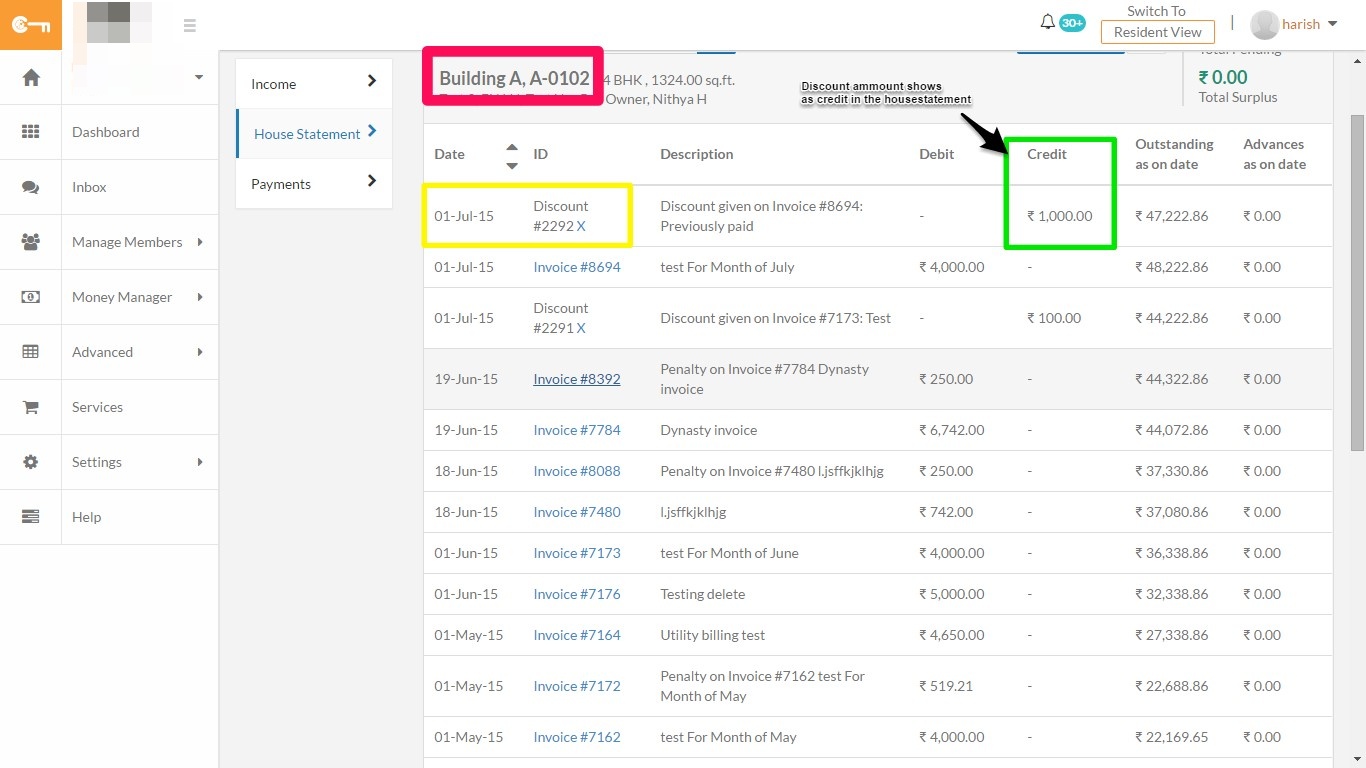
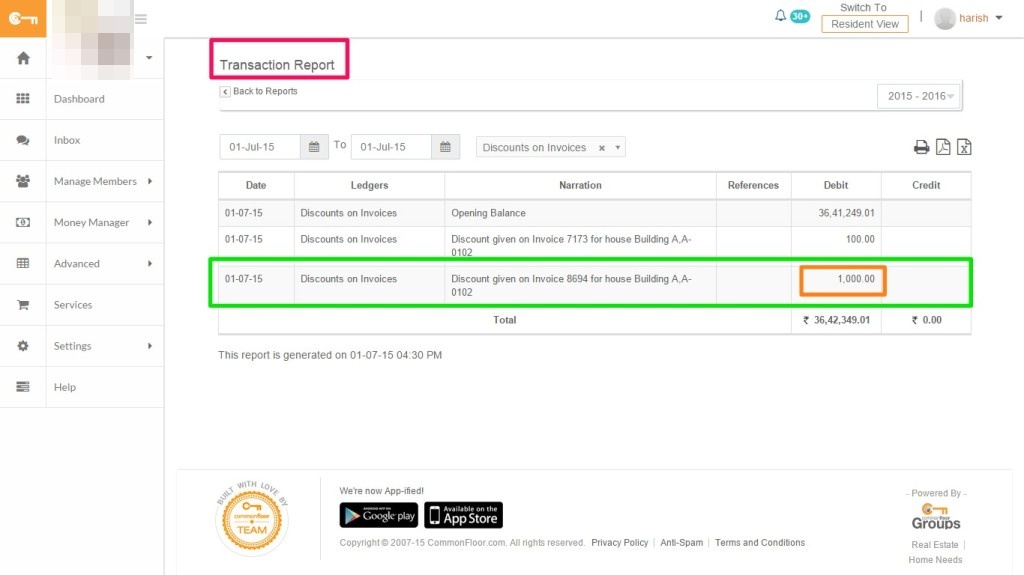
This discount will now show in your ‘house statement’ and also on the ‘transaction report’.

To access the ‘House Statement’ click on Money Manager then Income and you will find ‘House Statement’. Here you can look for the invoice for the month where the discount had been applied against your house number. (In our case it would be July 1st 2015 for house A,A0102). The Discount amount imposed will appear in the Credit of the house statement.

Note: The outstanding amount of that invoice and outstanding amount for the house will decrease with respect to the discount amount.

Money Manager> Income> House Statement

3showing-credit-3

As mentioned above this discount would also show up on the Transaction report. Select the Ledger of ‘Discounts on Invoices’ and here the transaction of Discount is shown as a Debit (this is the other ledger impacted by the discount entry).

Once discounts are applied both SMS/email will be triggered to the resident of the house.

Money Manager>Report> Transaction Reports> Choose Ledger>Discount on Invoices (in this case)

4Transaction-report1-1024x575

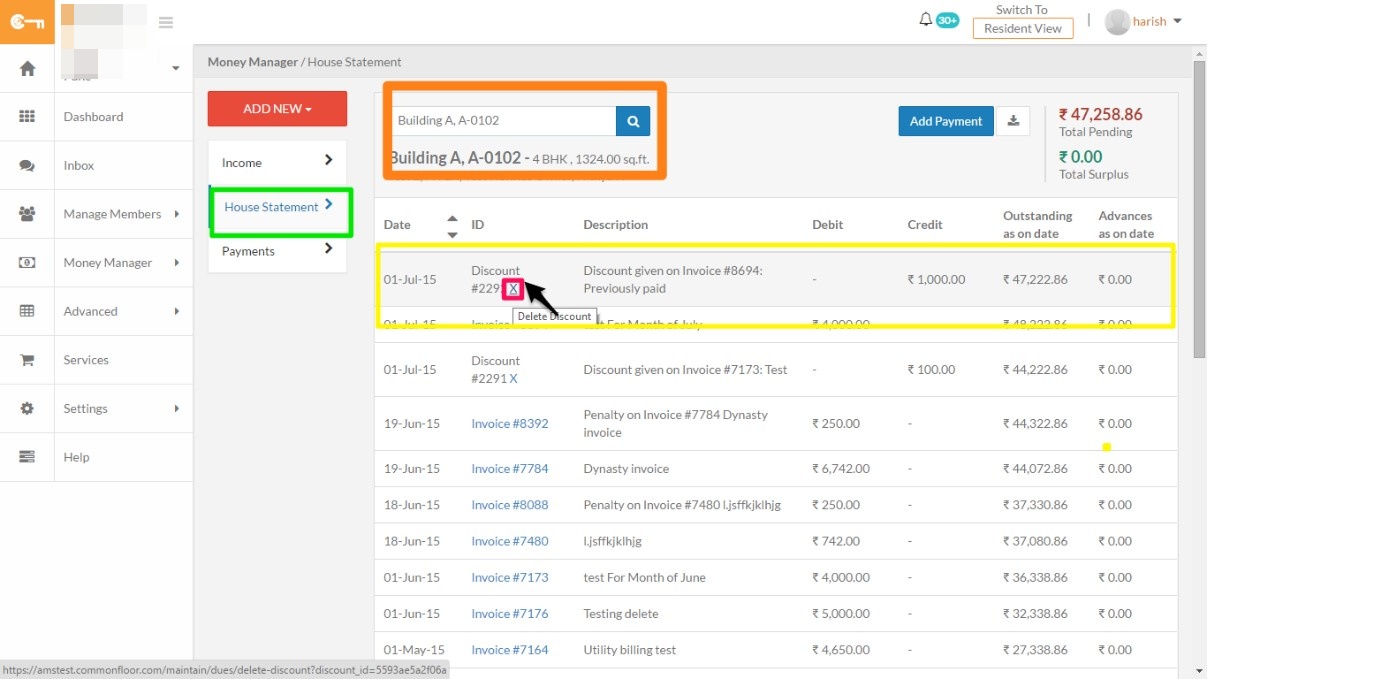
Lastly, to delete enter into the particular house and click the ‘delete’ button. Access it from the ‘House Statement’ option and put in your house number.

5deleting-discounted-invoice

Read More
maintenance Right Step uncategorized

Earth caves in under one of Bangalore’s posh high rises- 32 flats evacuated

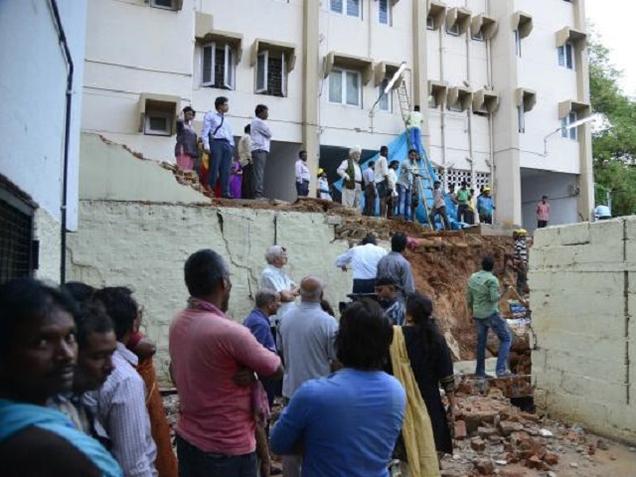
People living in high rises have one nagging fear, their building being one of the firsts to collapse in the face of an earthquake. June 15th was one such day for the residents of the posh Queens Corner Apartments. Tremors were felt and with vivid images of the Nepal earthquake still fresh it was found out much to their dismay that a large section of the compound wall had collapsed along with a huge tree which even created cracks on the building. The collapse has affected not only apartments of Queens Corner but also the houses in the neighboring Income Tax Colony.

Queen's Apartment Bangalore

The reason is stated to be a huge excavation which was done very close to Queens Corner for the construction of a 20 storey building by Legacy Projects. However, residents are also saying that a large pipe which is close to 15 inch in diameter has been leaking for more than 10 days which had been left unattended in spite of making repeated complaints to the BWSSB and this has resulted in the earth loosening further caving in the earth and hollowing out a major section of area. So there’s this one enormous pit dug out by Legacy Global Projects Pvt. Ltd. for an apartment complex in the adjoining plot and the huge crater just below Queens Corner due to the earth caving in. The hollow which is about 15-feet deep just near block C of Queens Apartment have sacred the residents out of their living dreams and 32 flats of an entire block in Queens Corner apartment, Queens Circle were evacuated along with many residents of the affected Income Tax Colony. Residents evacuated from Queens Colony has either moved to hotels or homes of relatives while residents of the Income Tax Colony has been shifted to guest houses.

Lal Mirpuri, president of residents’ association of Queens Corner stated that repeated complaints had been made not only to BWSSB for fixing the leaking pipe but also to Legacy Projects just after they had dug out the huge pit which had resulted in cracks in their building. As per Defence News India, He also claimed that the association members had made several requests to Legacy Projects for building retention walls in the pit they had dug but all in vain. However, Legacy Global Projects claimed that the large concrete pylons they had built against the mud wall had also collapsed in the accident.
Legal action has already been taken and the builder has been booked under section 336 of the Indian Penal Code for an act endangering life or personal safety of others.

What would you do if something like this happens near your housing society? Any proactive way to deal with such situations?

Source :- http://goo.gl/jDfoHR

Read More
uncategorized

5 Tip to Make Your Home Summer Ready

Summers are a real pain in India with almost all the cities suffering from high humidity, a high discomfort index and cities like Delhi, Lucknow, Kolkata and many others even experience severe heat waves. So being prepared for the extreme temperatures is of utmost importance. But, to be honest, most of us take it quite casually and depend entirely on air conditioners. This results in temperature fluctuations and we  fall sick due to it. Also, usage of A.C’s continuously means having to pay really high electricity bills etc. Thus, keeping in mind the summer woes that we face, here’s a checklist of five important things that you must take note of to help you sail through the Indian summers.

1. If the air conditioners are switched off the general idea is to keep the blinds and windows open to let the air in. Well, it’s a bad idea as the air is hot and all it does is warm your homes. In fact, its always best to close the windows and pull the blinds before noon as this would help to keep your houses much coolers. Also sprinkling some water on the floor and then switching on the fan for allowing the water to dry off would also help in the cooling process.

2. Another way of ensuring a cool home during summers is to have black windowpanes which blocks sunlight almost entirely. Choose for low solar heat gain coefficient panes. However if this sounds a little expensive then simply go for the reflective film, sunscreen-fabric curtains, or roller shades. During winters you can simply uninstall them to let the sunlight in.

3. Refrigerators are a lifeline during summers. Not only to keep food items from rotting but also for us to have cold drinks, cold water and ice cubes. So maintaining the refrigerators are quite important. Condensing coils are the ones that have the highest chances of going bad as most of us don’t really clean it well. Also, remove the base plate or top grate and clean well. Best would however be to get a servicing done just before the summers.

4. We love colors and the same is seen in our home decors and bed spreads. But during summers do use lighter linen, material wise and even color wise. Use light pastel colours or better still white which would help to give your rooms a breezy feel. In fact, if it’s really hot then simply put the linens in a plastic bag and put in the refrigerator for a little while. Then take it out and spread it just before going to bed. A great way to beat the heat.

5. Don’t forget to ensure that there’s plenty of fresh air in your homes. So allow cross ventilation and place houseplants wherever feasible. Some of the best air-cleaning houseplants are snake plants, spider plants, English ivy, and small-leafed rubber plants.

 Here’s hoping these tips would help you enjoy a much cooler summer without having to spend much and the intense Indian summer would not really bog you down as such. Happy Summers!

Read More
Right Step Tips uncategorized

Tips for Making Your Home Earthquake Resistant

Lockwood icons_Earthquake_Brown

Earthquakes can occur at any place and at anytime and if one is not prepared the loss to property and life would be unimaginable. In the wake of the recent earthquakes that hit Nepal and flattened many of its towns and historical structures we at CommonFloor felt it our responsibility to inform each one of you about earthquake proof houses and how to ensure that your abode is earthquake resistant to a large extent, if not entirely. We say ‘not entirely’ as building entirely earthquake proof houses is extremely expensive and may in fact be  impossible.

Firstly, if you are getting your house/apartment built then you have to know which part of India you live in. India is divided into mainly two zones- one being the high seismic zone and the other one being the low seismic zone or may be nil. The northern part of India falls around the high seismic zone and hence buildings there must be built in a way to be able to sustain jolts of a minimum of 4.5 in the Richter scale. If you are buying a house then make sure to get the structural design from your builder so as to get it checked by experts. It might be a lengthy process but it’s always important to be safe.

If you are in the process of getting your house built then here are some of the ways through which you can ensure an earthquake resistant house. To begin with, include shear walls, shear core and cross bracing when the foundation is laid. Support walls are known as shear walls and are mainly laid around staircases or elevator shafts for providing a better grip to that hollow space. Don’t forget to get the walls strengthened and supported by diagonal steel beams known as cross bracing.

Moving on, add the base isolator methods which acts as shock absorbers between a building and its foundation. These shock absorbers are made of alternate layers of steel and a type of synthetic rubber acting as a spring during earthquakes. These absorb the to and fro motion.

Other ways of keeping your house earthquake resistant is by building it on a column which is placed as deep as 2 ½ meters under the ground. Beams must be placed to provide extra support and the roofs must me made extra sturdy. The bars in the column should be minimum 12 mm thick with about 900/900 foundation.

Apart from the above if you have a plot it’s advisable not to directly go into building a house there as the soil might not be fit enough to take weights. Even if it is, it’s important to know how much weight it can take. In such situations do get the soil tested which can be done by a number of private and even semi-government agencies. These agencies would tell you how much weight the soil can take, whether construction is at all possible and so on.

So, find the right builder, carry out the necessary, though lengthy research work and get on with your dream home.

Read More
1 55 56 57 58 59 73