Product Updates

Increase your Maintenance Due Collection with our ‘All New Invoice’

Create Invoice recurring (1)


Raising invoices and collection of maintenance dues is one of the biggest pain point of all the apartment managing committee members and this is where CommonFloor Groups can help the most. Based on feedback from a lot of our users, we have completely revamped our Invoice feature in the Money Manager module. It’s super easy for Admins/ Treasurers to raise maintenance dues/ other invoices and for residents, to pay those on time.

 What should you look for:

  • Complete Makeover: Raising an invoice is now a breeze – you will now have to key in minimum data while raising an invoice, making the process significantly simpler and faster.
  • Multiple Items within an Invoice: You no longer need to raise separate invoices for different particulars. All you need to do is, create a single Invoice detailing each type of charge in a separate line, making the break-up of the Invoice amount completely transparent to all residents.

  • Consolidated Settings View: All the configuration options/ settings such as Penalty, Service Tax, Round-off settings have been moved to ‘Setup’ as these needn’t be updated every time an invoice is raised. You can configure these once, and it will be applicable for all the invoices going forward

  • Save items for future: Save an entered line item along with its settings and calculations for future use.

  • Round-off Invoice Amounts: Round-up tiny decimal values, so that the final amount is easy-to-remember/ pay for residents!

  • Mobile-friendly Emails: All notification emails from Money manager module are now modified so that it can be viewed clearly on mobile devices/ tablets.

 What’s coming up:

Quite a lot of residents make advance payments on their maintenance dues, and the Admin currently need to update the payments on each Invoice separately – we are working to make this automatic and reduce a lot of manual effort for Admins. Keep watching this space for more!

 We’d like to hear your thoughts on how you personally think these enhancements will help your society. Please share them with us along with your feedback on the same (if any) in the comment section below.

 

Read More
Smart Residential Living

What Suits Your Housing Society: CommonFloor Groups vs Yahoo Groups

CFG-vs-Yahoo-Groups_P1

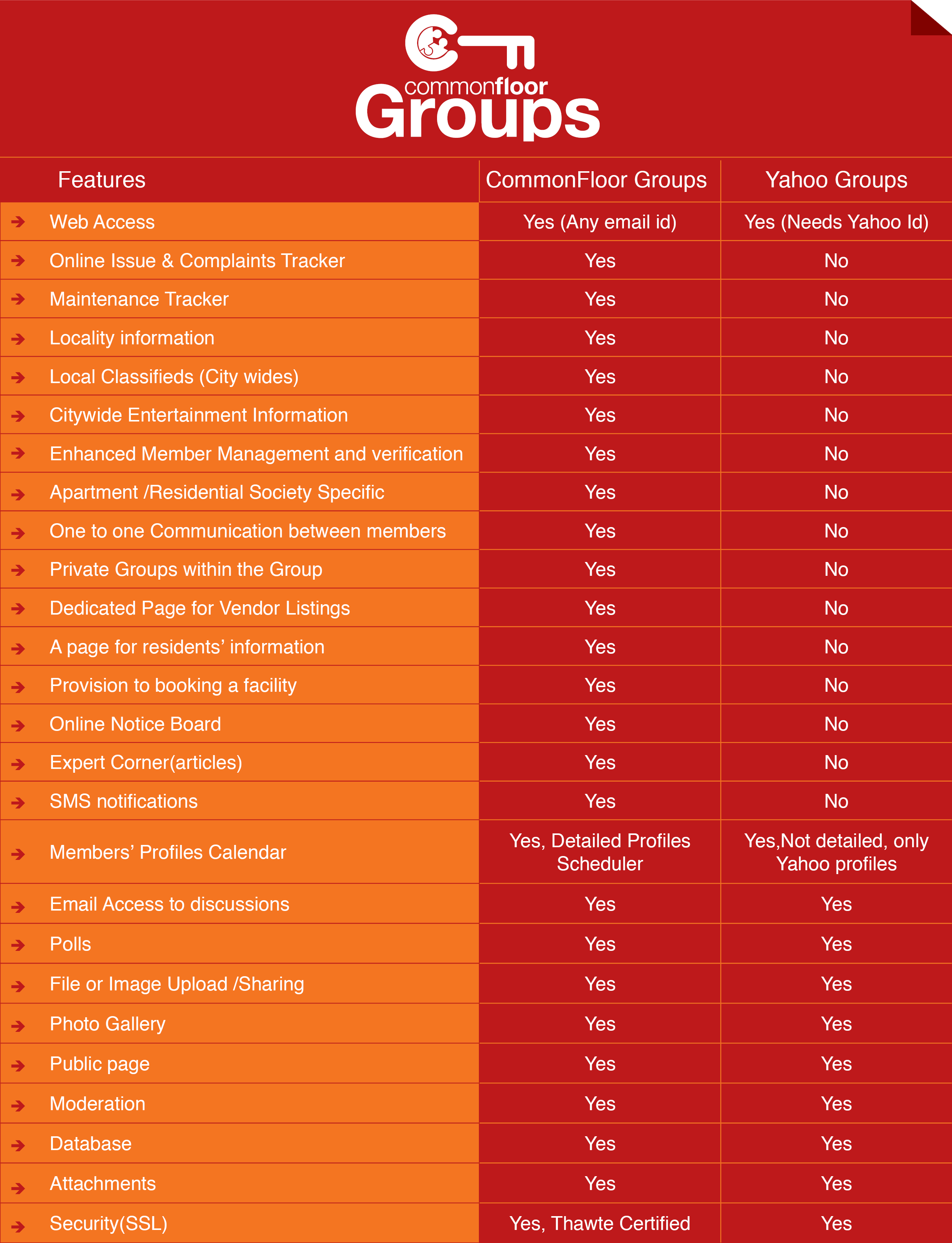
Yahoo Groups is mostly a discussion board which can be adopted by a residential community to network while CommonFloor Groups (with its communication, money & account management, member management, issue management, vendor management features) is a tool designed to facilitate easy functioning and managing of a residential complex.

Now, let’s carefully analyze detectable features of both and see how they’re different.

CF groups Table (1)

After browsing through the above table, what we observe is

Yahoo Groups and CommonFloor Groups, both including the term ‘groups’ in their names, serve as a platform to hold discussions related to one’s complex, but are certainly not two different tools serving the exact same purpose. CommonFloor Groups is precisely a portal very distinct from Yahoo Groups in terms of their end objectives and characteristic set of features.

If you have any question, do write to us at support@commonfloor.com


Read More
Fun Posts Product Updates Smart Residential Living

CommonFloor Groups Android App-A Step towards Awesomeness

Let’s start with a fun way to look at the features of CommonFloor Groups’ new mobile app.

Android Mobile App- CommonFloor Groups


Let’s sum up what we figure from the picture above. Our app’s most prominent features include:

1) Newsfeed

2) Discussion

3) Complaints

4) Notices

5) Neighbours

6) Messages

7) My House

8) Settings

9) Moderate

Here, we simply try to give you a basic idea of the app. To experience its complete awesomeness in easing intra-society communication and management, download Now! Click Here

Now, let’s take a look at how our users have responded (with app activities) over the last 2 weeks.

Android App DataGood News! We are bringing out our iOS version very soon!

What do you think of this post? If you have interesting ideas for fun posts you’d like to read on this blog, please feel free to type them down in the comment section here.

Read More
Smart Residential Living

Know How Much Service Tax a Society Needs To Pay

Service tax society needs to pay


As the name suggests, service tax is a certain tax imposed by the government on services provided.

In a society, if residents avail of the services provided by the Management Committee, service taxes come into the picture.

We hope to clear some of your basic service tax related doubts with this article.

Let’s draw different situations and understand how much service tax the Management Committee is obligated to pay in each case.

Case 1: If a resident pays more than Rs.5000 towards Management Committee provided services, service tax will be calculated on the whole amount and not just on the amount exceeding Rs.5000.

Case 2: If a resident pays up to Rs.5000 towards Management Committee provided services, no service tax is applicable.

Case 3: If in a financial year, the aggregate value of taxable services offered by the Management Committee does not exceed Rs.10 lakhs, no service tax is applicable. In case the aggregate value of services exceeds Rs.10 Lakhs, the Management Committee is liable to pay service tax only on the amount exceeding Rs.10 Lakhs.

Case 4: When a Management Committee merely acts as a ‘pure agent’, i.e. collects money from residents for various services used such as electricity, water (without adding any extra charge) and transfers the same to the respective authorities concerned, the service falls under the ‘non-taxable services’ category.

However, service tax is applicable on electricity utilized in society common areas.

Note: Management Committees are allowed a set off if they avail of CENVAT credit.

To take a look at the circular published by the Ministry of Finance in January 2014, click here bit.ly/V8IFac

If you still have concerns related to service taxes applicable to housing societies, please write to us at support@commonfloor.com

Read More
Fun Posts Smart Residential Living

10 Common Household Items You Can Easily Re-Use/Recycle

Blog on waste recycle


Do you know – a part of the rubbish you toss into your garbage bin daily can be re-used to serve some other household purpose?

This way you can save yourself money by using these as substitute items for things you would have had to buy otherwise. This will, in turn, control your inorganic waste contribution for landfill.

 Here is a short list of articles you can recycle without any entailing trouble:

1) Old CDs: Make artistic coasters out of old CDs by drawing or painting on them or coating the upper surface with magazine pictures and bottom surface with felt.

2) Carry Bags: Use plastic bags as garbage bags or carry it along to get items from your nearby departmental store.

Use paper bags as gift-wrappers or as paper to jot down things you need to purchase. Wet-wipe containers can serve as great string dispensers.

You can easily use take-away containers, glass jars and small pots to store cakes, needles, threads, buttons, coffee beans and spices.

Try filling little lip balm boxes and toiletry containers from bigger bottles. They make compact travel-friendly packs.

3) Twist Ties/Ropes: These can prove considerably helpful to secure wires and other material while shifting homes or to simply store junk in your storage room.

4) Old Envelopes: Reuse an old envelope by sticking a new address slip over the former address section. You can use them as scrap paper alternatives as well.

5) Scrap Paper/Newspaper: Utilize newspapers to package belongings while shifting or to package items neatly, mark and keep away for later use. You can make use of scrap paper as scribbling or doodling paper. A creative hand-made Birthday or New Year card is always treated specially and you can make one from old postcards, stamps and photos using material such as sequins, sand, beads and threads to decorate.

6) Cardboard/Bubble Wrap/Foam: Keep your objects safe while moving out/in by covering them with bubble wrap or foam before placing them in cardboard boxes. It can also be used as an insulation material on walls and floors.

7) Tyres: Recraft old vehicle tyres into funky tyre-swings and place them in your balcony, garden or terrace.

8) Scrap Wood: Wood scraps can be used to make handicraft items, a small corner table or a spice rack. People with an in-house fireplace will surely love the idea of free firewood.

9) Cork: Use these to make cork message boards, key-chains or to beautify your front door.

10) Old Clothes: If you have clothes you no longer want to wear nor want to throw away, you may cut them out to make pretty covers for your pillows, sofa cushions or teapots.

Get creative by cutting patches from your old denims and stitching them onto new ones.

So, if something you consider useless is lying in some dusty corner of your home, pick it up, dust it off & start putting it to some good use!

And if you have clothes, books or furnitures that you absolutely don’t want to keep, you may consider giving them away to NGOs for people who will be happy to use them.


Read More
1 67 68 69 70 71 73